Skip to content
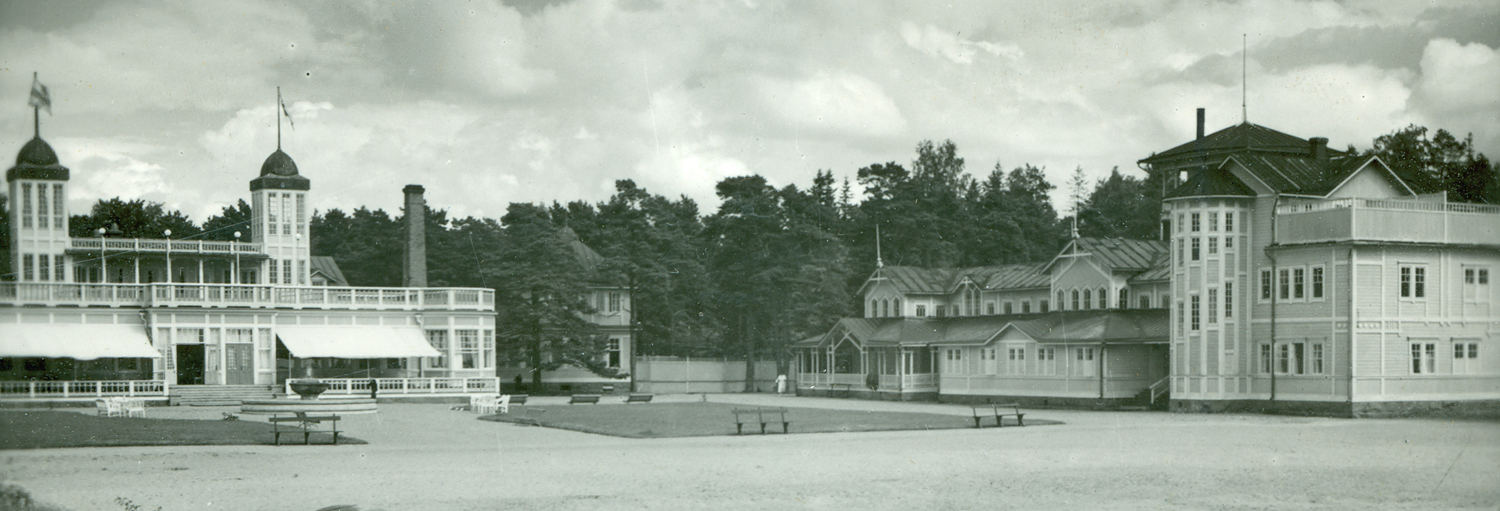
Seurahuone ja kylpylä 1900-luvun alussa. Societetshuset och Hangö bad i början på 1900-talet. The restaurant building and the spa buildling in the early 1900s.

History of Hanko

800-1050
800-1050
Vikings sail past Hanko. In 1924 a bracelet was found in the Western harbor, and it has later been donated to the National Museum of Finland. Photo: The National Museum of Finland
13th century
13th century

The name Hanko Peninsula is mentioned for the first time in a written source. The Danes had conquered Reval (Tallinn) and they needed information about a safe route from Denmark to Tallinn. The route went past the peninsula of Hanko. Hanko had a name in both Finnish and Swedish; Cumiupe and Hangethe. Lowicsund (Tvärminne) is also mentioned on the map.

1568
1568

Claes Fleming visits the island of Gäddtarmen and his magnificent coat of arms is engraved into the cliffs, alongside with hundreds of other coats of arms made by those, who travelled to the Baltic region in the 16th–18th centuries.

1631
1631

The first mention of a chapel in the harbor that is nowadays known as the Chapel harbor. It is however likely that the chapel was built in the 15th century. Its exact location is unknown, but in 2006 the chapel’s cemetery was discovered. In 1935 the society of Hembygdsforskningens vänner i Hangö raised a memorial on the place, where they believed the chapel had been.

1647
1647

Hans Hansson’s map of the village of Hangöby is dated this year. The village had five homesteads and the fields and the pastures are meticulously marked for taxation.

The 21th of July 1714

The Battle of Rilax is fought north of the Hanko Peninsula. This is the Russian navy’s first victory over Sweden. In 1964 a medal is minted in honor of the Swedish navy commander Nils Ehrenskiöld.

1748
1748

Hangöby still has five homesteads and their lands have been divided into lanes, so that every farm has many narrow lanes on every field. The map is drawn by Hans Fattenborg.

1754
A. Ehrensvärdin kallionhakkaus vuodelta 1821 Hauensuolella. A. Ehrensvärds inristning från 1821 på Gäddtarmen. A.Ehrensvärdin kaiverrus vuodelta 1821 on the cliffs of Gäddtarmen.

Augustin Ehrensvärd leads a group of men that measure the waters surrounding Hanko with a possible fortification in mind. In addition of the Hanko Peninsula, a fortification was planned outside of Helsinki, where it was later founded and named Sveaborg.

1790s
Gustavsvärnin rauniot. Gustavsvärns ruiner. The ruins of Gustavsvärn.

The permanent fortification of the Hanko Peninsula begins after the end of the Russo-Swedish War in 1790. Three islands south of the peninsula are fortified and given new names: Gustafsvärn, Gustaf Adolf and Meijerfeldt. On the mainland the cliffs of Drottningberg are fortified too.

1855
1855

The English cut down trees along a wide lane on the Tulliniemi cape, and use it as a sea mark during the Crimean war (1853–1856), when all other sea marks have been removed by the Russians. The Russians blow up the old Swedish fortifications.

The 8th of October 1873

The Hanko–Hyvinkää railway is opened for traffic after mor than ten years of planning. The railway is privately owned, but is unprofitable and sold to the state in 1875.

1873
1873

The port of Hanko is put to use. It is Finland’s first winter harbor and the expectations are high.

The 10th of January 1874
Hangon ensimmäinen asemakaava 1874. Hangös första stadsplan 1874. The first city plan of Hanko from 1874.

The city of Hanko is founded on a small area south of the railway.

The 15th of December 1877

The ice-resistant ship Express starts operating between Hanko and Stockholm. The ship carries mail and passengers.

1879
1879

Hanko has already had a winter harbor for six years, but the city also needs business in the summer time, and therefore the city’s spa is founded.

1886
1886

Oy Granit Ab is founded. Granite is quarried from and processed near the cliffs of Drottningberg and then exported to among other places Helsinki and St. Petersburg.

the 1880s
the 1880s

A steam sawmill and carpentry factory is established in Hanko. The factory manufactures many of the villas in Hanko.

1890
Tennispelaajia ja lapsia Casinon edustalla. Tennisspelare och barn framför Casino. Tennis players and children in front of the restaurant building Casino.

This is the club house of the country’s most fashionable spa. It is nowadays known as the Casino. Croquet and tennis can be played in front of the building.

1890
Mannerin konepaja rakentaa radiomaston. Kuvassa näkyy sekä tehdas- että asuinrakennuksia. Manners mekaniska verkstad bygger en radiomast. På bilden både fabriks- och bostadshus. The Manner mechanical workshop buildling a radio mast. There's both factory and dwelling houses in the picture.

The Manner mechanical workshop is founded. They have among other things manufactured the well-known Hangon keksi tin cookie jars. Nowadays, the company manufactures castors.

The 1890s
Vesihoitoja Hangon kylpylässä. Vattenbehandlingar i Hangö bad. Water treatments in the spa of Hanko.

The most important activities of the spa are the daily baths, either inside the spa or outside in a fenced area in the sea. The nature of the treatments depend on what kind of illnesses one wants to cure. However, water is the most important means of treatment.

1892
Hangon kirkko ja raatihuonentorin puisto 1890-luvulla. Hangö kyrka och rådhustorgets park på 1890-talet. The church of Hanko and the park in the 1890s.

Hanko’s Evangelical Lutheral church, planned by Jac. Ahrenberg, is built.

1893
Oy Forcit Ab

Finska Forcit-Dynamit Ab is founded. The company still produces explosives.

1895
Hangon ortodoksinen kirkko. Hangö ortodoxa kyrka. The orthodox church of Hanko.

The Orthodox church of Hanko is built for the Russian spa guests.

1902
Siirtolaisia hangon siirtolaishotellin edustalla. Emigranter framför Hangös emigranthotell. Emigrants in front of the emigrant hotel in Hanko.

Around 23.000 emigrants leave Hanko for North-America this year. The steam ship company Suomen Höyrylaivaosakeyhtiö builds a hotel for emigrants on the Boulevard in Hanko the same year.

1902
Tvärminnen eläintieteellinen asema. Tvärminne zoologiska station. Tvärminne zoological station.

Tvärminne Zoological Stations is founded. To this day the station still researches Hanko’s diverse nature.

1906
1906

In 1906 and 1907 30.000 Russian Jews travel as emigrants from Hanko to North America. The steam ship company Suomen Höyrylaivaosakeyhtiö builds them a hotel at the corner of Nycandeirnkatu and Korkeavuorenkatu.

1909
1909

The Museum of Hanko is founded. The museum is founded by the local society of Hembygdsforskningens vänner i Hangö that wants to preserve old knowledge about and artifacts from Hanko.

1909
Voimakasiini ja junaratoja. Smörmagasiner och järnvägsspår. The butter magasine and railway tracks.

The butter warehouse is put to use in Hanko. Butter is one of Hanko’s most important export products.

The 8th of June 1910
Seurahuone ja kylpylä 1900-luvun alussa. Societetshuset och Hangö bad i början på 1900-talet. The restaurant building and the spa buildling in the early 1900s.

Finally, the renovated and expanded spa and restaurant opens. Spa guests arrive to Hanko in order to revive themselves for six weeks.

1910
Hangö Kex -mainos. Hangö Kex -reklam. Hangö Kex ad.

Finsk-Engelska Biscuit-fabriks Ab is founded. The cookie factory produces the famous smiling Hanko cookies until 1940.

0